
The Industrialization of Creativity: Why Process is the New Competitive Advantage
This is a pivotal moment for our industry. The report you’ve shared is a masterclass in the structural shifts we are seeing at the enterprise level, and it aligns perfectly with my view: The "democratization" of AI tools means that the tools themselves are no longer the advantage.

In my 20 years as a marketing strategist, I have watched the "Iron Triangle" of project management;Quality, Speed, and Cost. Act as an unbreakable law of physics. You could have it fast and cheap, but it wouldn't be good. You could have it good and fast, but it would cost you a fortune.
Today, that triangle isn't just breaking; it’s collapsing.
The rise of Generative AI and agentic workflows has introduced a deflationary pressure on creative production that renders the traditional agency model obsolete. But here is the nuance many are missing: When everyone has access to the same "magic" tools, the magic becomes a commodity. I believe we are entering the era of the Industrialization of Creativity. In this new landscape, creative people and agencies must shift hard and lean into adopting new processes to better orchestrate AI. It is no longer about who has the best prompt; it is about who has the best "factory." The process, the way we chain agents together, fine-tune models on brand DNA, and automate the content supply chain is what will determine the winners in 2030.
The Efficiency Paradox and the Death of the Billable Hour
For years, the "billable hour" was the industry’s primary currency. It was a model predicated on the scarcity of human talent. If a campaign took 500 hours to design, the agency billed for 500 hours.
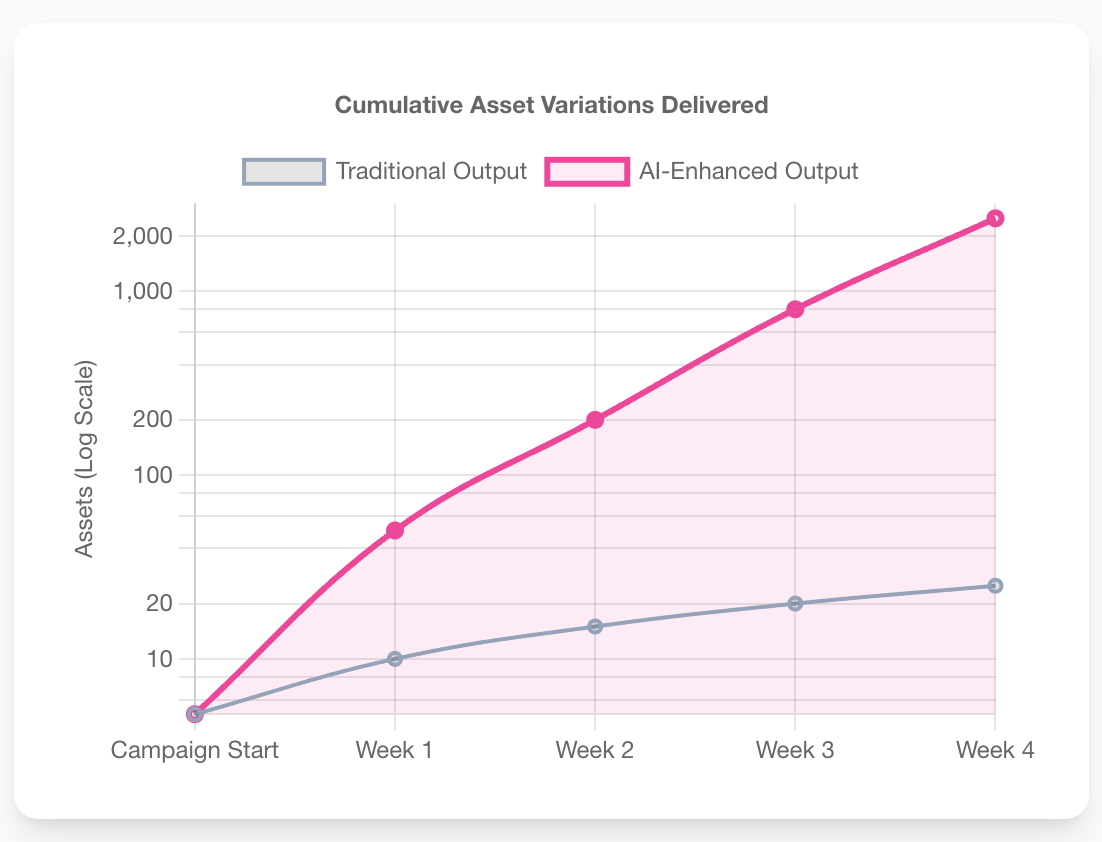
But what happens when those 500 hours of "grunt work"; retouching, resizing, localization, now take 50 seconds?
This is the Efficiency Paradox. If an agency continues to bill by the hour while using AI to increase efficiency by 10x, its revenue will plummet by 90%. Conversely, if an agency refuses to adopt AI to protect its billable hours, it becomes a dinosaur, unable to compete with tech-forward rivals who can deliver 1,000 personalized assets in the time it takes to brew a pot of coffee.
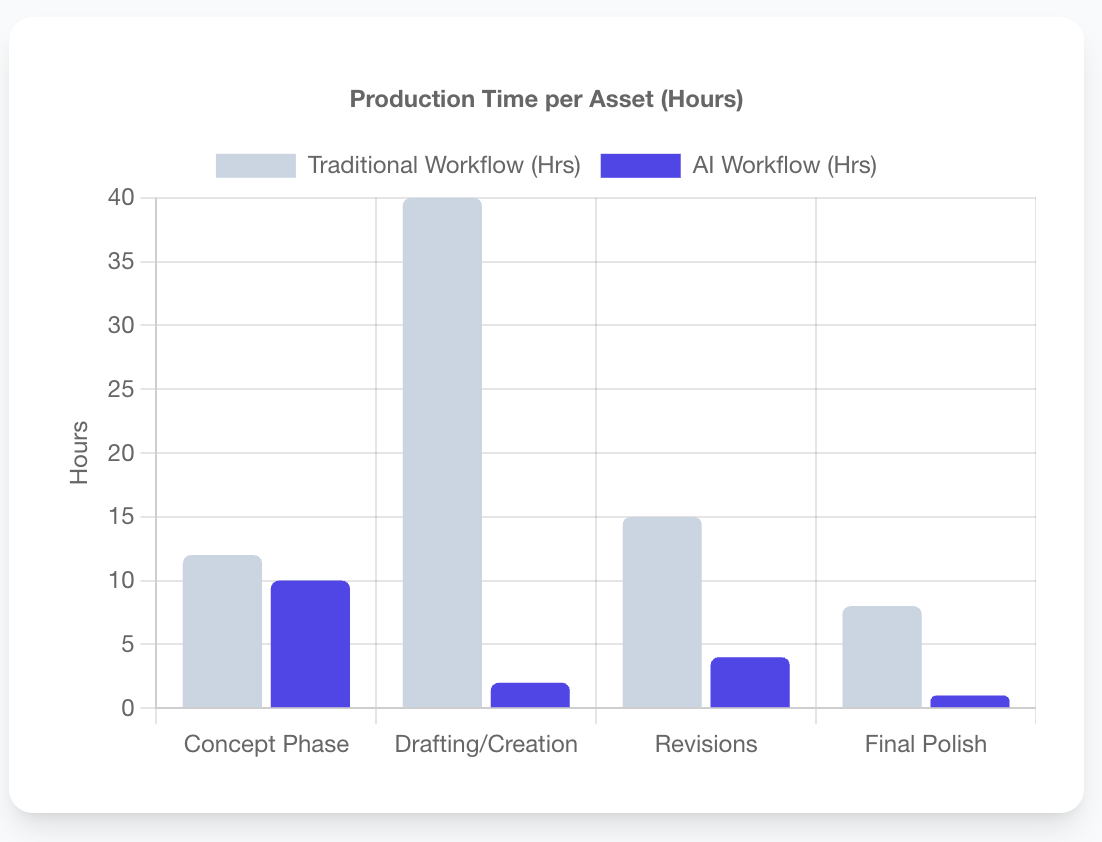
The strategic shift I’m advising is a total migration away from "hands-on-keyboards" pricing toward Asset-Based and Outcome-Based models. We must stop selling our time and start selling our "Content Engines."
- Asset-Based Pricing: You aren't charging for the hours spent on a banner; you are charging for the value of a 1,000-variation personalized creative matrix.
- Outcome-Based Pricing: This is the high-stakes frontier. By using agentic AI to continuously test and optimize creative in real-time, agencies can finally tie their fees to ROAS or Sales Lift with statistical confidence.
From Prompting to Orchestration: The Rise of Agentic Workflows
Most marketers are still stuck in the "chatbot" phase, typing a prompt and waiting for an output. That is artisanal AI. The industrial version is Agentic Workflows.
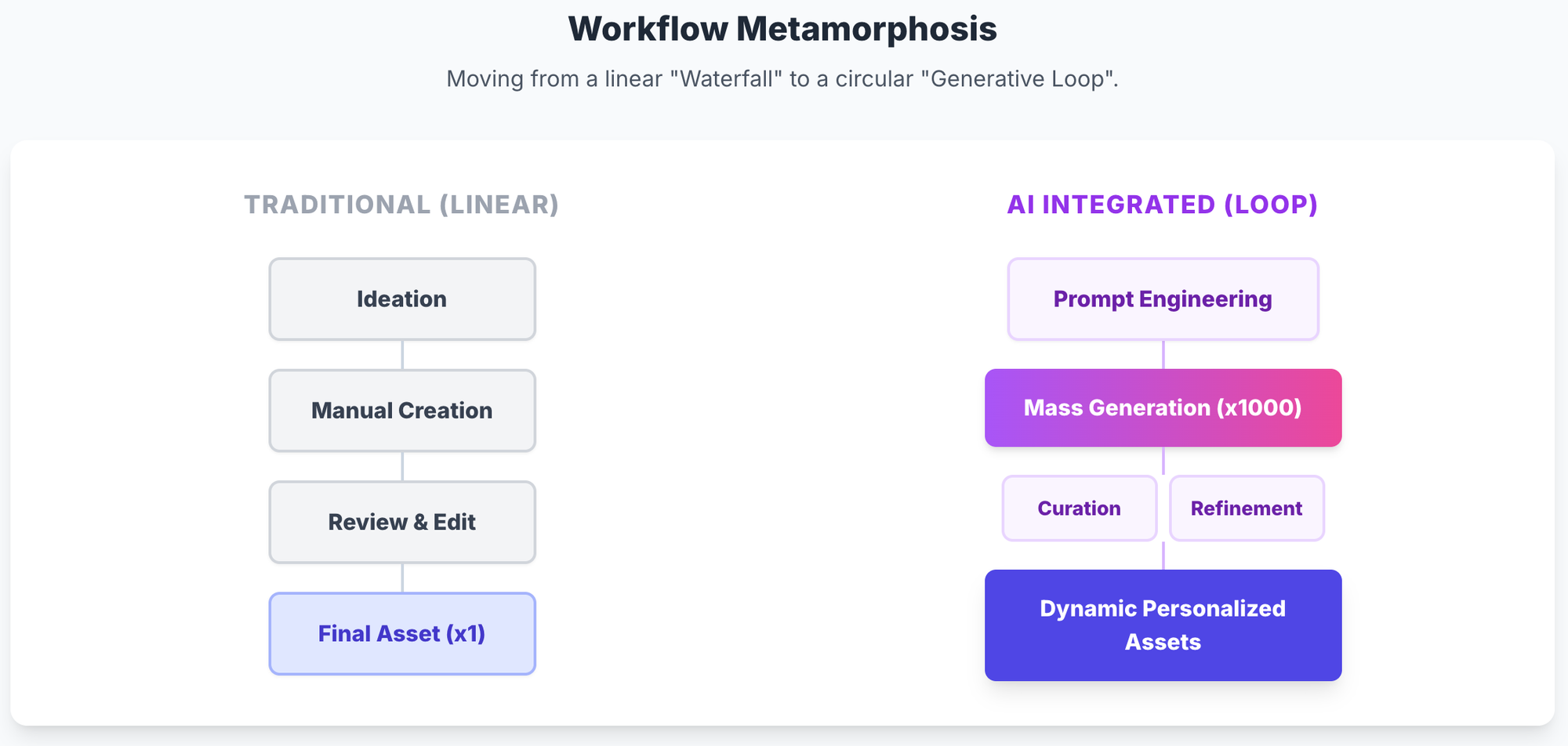
In my experience, the real metamorphosis happens when we move from "Generative AI" (creating content) to "Agentic AI" (executing workflows). This involves deploying autonomous agents that operate in loops of Perception, Reasoning, and Action.
Imagine a workflow where a "Media Ops Agent" monitors your campaign data. It perceives that a specific audience segment is underperforming. It reasons that the creative "hook" is failing. It then autonomously triggers an image generation tool to create new visuals, calls an LLM to rewrite the copy in the brand’s specific voice, composites the ad, and launches it, all without a human needing to click "save as."
This isn't science fiction. Agencies like Media.Monks and WPP are already building these "operating systems." The goal isn't to replace the human; it’s to integrate a Human-in-the-Loop (HITL) at critical "judgment" checkpoints, allowing the machine to handle the 90% of execution.
Building the Brand-Safe Factory: LoRAs and RAG
The biggest hurdle to mass-produced creativity is Brand Consistency. A generic AI model doesn't know what a Nike shoe looks like or what a Coca-Cola "red" feels like. This is where the "Industrialization" requires technical sophistication.
To maintain brand equity at an industrial scale, we are seeing the emergence of:
- Digital Twins: Moving from physical photoshoots to 3D product models (using OpenUSD) that can be placed in any AI-generated environment instantly.
- Fine-Tuning & LoRAs (Low-Rank Adaptations): Training "adapter" layers on top of base models so the AI strictly adheres to a specific brand’s visual language.
- RAG (Retrieval-Augmented Generation): Connecting LLMs to a brand’s private knowledge base; style guides, past winners, and legal "no-gos" to ensure the machine never "hallucinates" outside of the brand voice.
When you combine these, you create a "Walled Garden" where creativity can be mass-produced without the risk of legal or aesthetic drift.
The "Junior Crisis" and the Talent Inversion
We must address the elephant in the room: What happens to the junior creatives?
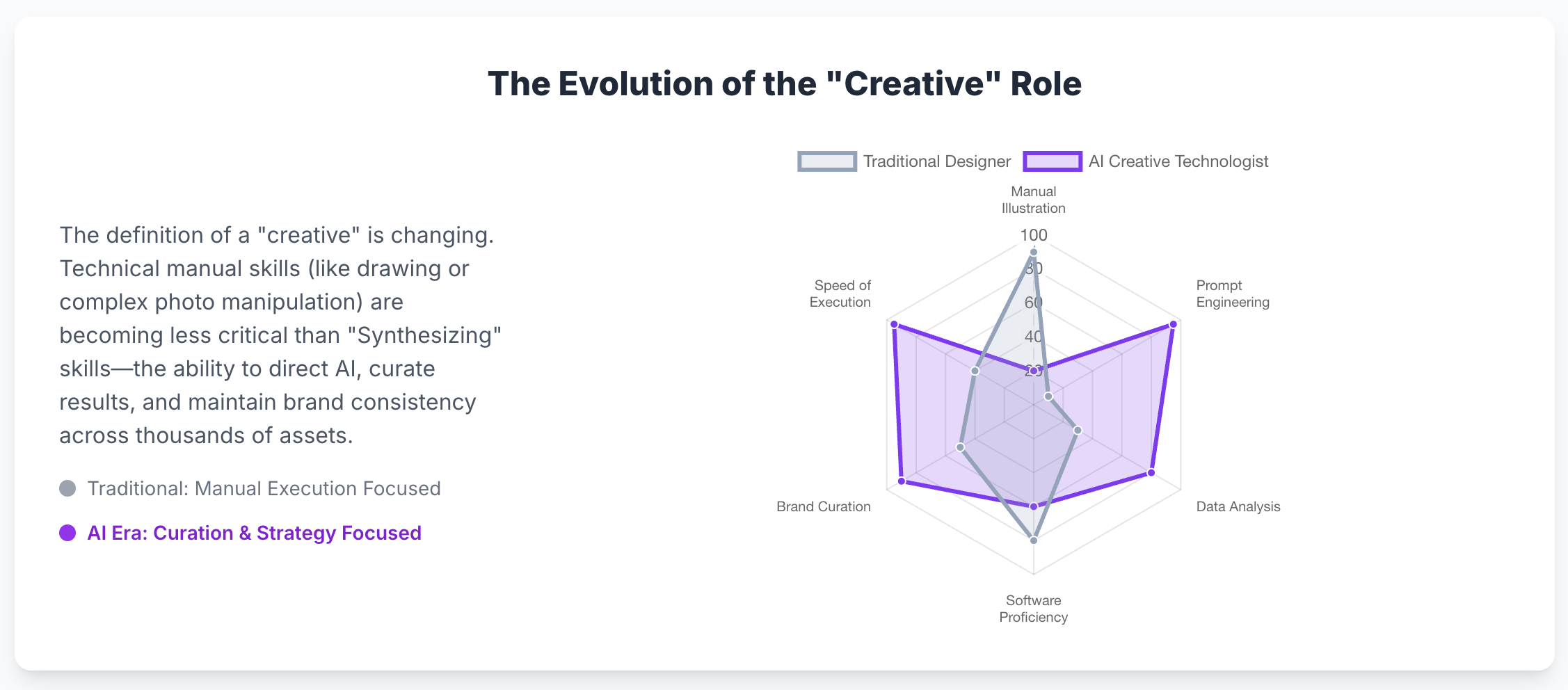
Historically, the agency "pyramid" was built on junior talent doing the "grunt work" to learn the craft. Now, the machine does the grunt work. This creates a Junior Crisis. If you don't have to resize ads or write basic captions anymore, how do you train the next generation of Creative Directors?
The role of the creative professional is shifting from Creation to Curation. The new entry-level skill isn't "Photoshop proficiency"; it is "Strategic Curation." A junior today needs to be able to generate 100 variations, analyze the data on which one will perform, and refine the 5 best options. We are moving toward a workforce of Creative Technologists and Workflow Architects.
The Strategic Takeaway: The Bifurcation of the Industry
The future of our industry is splitting into two distinct paths. There is no middle ground.
- The Content Factories: Large, platform-driven agencies (the WPPs and Publicis of the world) that compete on scale, data, and efficiency. They will sell "Always-On Content Streams" powered by massive AI operating systems.
- The Strategic Boutiques: Small, elite teams selling pure human ingenuity, high-level brand strategy, and the "Big Idea" that the machine hasn't learned yet.
If you are an agency owner or a marketing leader, you must decide which one you are. If you stay in the middle, selling average execution by the billable hour, the industrialization of creativity will move past you.
The tools are common. The process is your new moat. It’s time to build your factory.

ZoomMetrix Newsletter
Join the newsletter to receive the latest updates in your inbox.